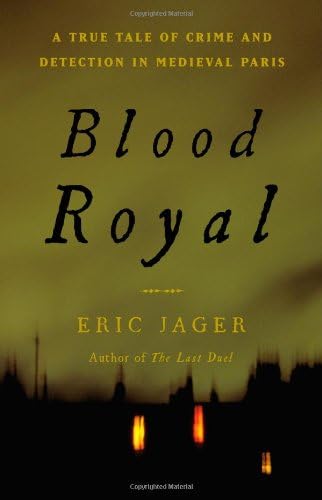

Blood Royal: A True Tale of Crime and Detection in Medieval Paris Hardcover – Illustrated, February 25, 2014
Product ID: 1355894
Buy anything from 5,000+ international stores. One checkout price. No surprise fees. Join 2M+ shoppers on Desertcart.
Desertcart purchases this item on your behalf and handles shipping, customs, and support to Vanuatu.
Full description not available
C**L
Bringing History Alive
I can recommend this book for so many reasons. For starters, I enjoy the historical "true crime" genre, especially when a book throws light on the lives of deeply interesting individuals whose personal histories are otherwise lost to the sweep of history.Note that I am not referring to a certain journalistic tendency to start every story with a multi-paragraph account of the numbingly uninteresting exploits of some random Joe Blow nonentity -- what my significant other's late father used to describe as "Yankel Koch" stories (the surname pronounced "Cock" for maximum percussive entertainment value).For Guillaume de Tignonville was no such cipher. The story of his life is the thread that runs through, enlivening without overwhelming, this incredibly detailed yet never daunting history of the late 13th/early 14th century French royal family and aristocracy and of the at times belief-beggaring developments that prolonged what became the Hundred Years War.I know Professor Jager and his amanuensis/aide-de-camp wife Peg. After reading this book, I am filled with an awestruck admiration for the scholarship and research that pulled this compelling narrative from often obscure primary sources. Thanks to my own abysmal attempt to create a performance piece from the Froissart chronicle on the six burghers of Calais, I know just how difficult it can be to make real history come alive. In this book the author has succeeded in doing so, and beautifully. His vivid descriptions of specific settings, clothing, consumer goods, events both mundane and cataclysmic reanimate every individual player in the story, from lowly long-suffering commoner to tormented mad king.Full disclosure: My birthday is October 25, St. Crispin's Day, so it is not surprising that I would be wildly enthusiastic about any book that is very much a build-up to the battle of Agincourt. But just as that 1415 date would be altered in the Georgian versus Julian calendar, so too my view on the war-like Harry/Hank Cinq/Henry V after reading this book. I still adore that Shakespearean play - as fiction. And for anyone who enjoys reading about the Tudors and the War of the Roses, I highly recommend this account of the contemporary, related, and equally sanguinary royal and aristocratic doings on the other side of the Channel. For those who are fascinated by the heroic/tragic Joan of Arc, this is a superb prequel.Again, the history is terrific, making brilliant use of the specific incident to shed light on the big picture. Professor Jager shows great respect for this pre-modern era. Just as he demonstrates that detective work was not an innovation of the 19th Century, so too he shows that total war was not an invention of the 20th. I found myself shocked by a "justification" of tyrannicide - something I thought a later coinage by Oliver Cromwell and crew - just as I was amazed by description of heavy artillery creating the same sort of craters, and in the same geographic locations, as the war of 1914-1918.Above all, this is an entertaining read. Several times I needed to put the book down for an "oh no" moment of anticipatory dread. The murder mystery does not itself take long to solve, but there is an edge-of-one's-seat tension throughout the narrative that keeps the reader eager to read on. And the text is filled with drily amusing observations: A description of an army corps noted for "their courage, their ferocity, and their propensity to commit atrocities"; an elderly duke best known for an exquisite Book of Hours but whose taste for lovely things also runs to "beautiful young men."Finally (just for fun) here are two trivia questions that came to mind while reading: What 1958 film takes its title from the medieval rite of excommunication? What 1849 short story by Edgar Allan Poe has an incendiary climax that mirrors actual events at the French court in 1393? No, I am not providing the answers. Read the book.
N**N
More Civil War than Crime and Detection
I can't help but feel that I was a bit misled by the way that this book is marketed and presented. The subtitle, after all, assures me that this is a true tale of crime and detection. However, there are only about two or three chapters that deal with the investigation of the crime itself. There's not really much of a mystery here; the crime and its culprit are quickly uncovered and if I am supposed to better appreciate the investigator's methods I don't feel that the book quite got me to that point.Most of the book is really about the civil war between powerful French families at the start of the 15th century. I didn't know much about this bit of history and being a history enthusiast I thoroughly enjoyed the bird's eye view of this event. As others have noted, the storytelling and writing are quite engaging. I recommend the book to people who want an introduction to this subject or who might want to kindle a spark of historical enthusiasm in someone who might think all this stuff is dull and boring. The story here is a real life game of thrones, with mad kings, daring betrayals, and even a hint of magic.However, I can only give 3 stars because the work feels incongruous to me. As noted, the investigation into the murder at the heart of the book is really quite brief. I was stunned when the author quickly revealed the perpetrator. In the end I was unsatisfied. I didn't get a nitty gritty exploration of true crime and detection (I should note I found the book through its exposure on the blog the Volokh Conspiracy and I had recently read The Faithful Executioner so I have some interest in law and history) and the book's larger subject, the French Civil War, breezes by. That sort of sweeping historical narrative doesn't quite fit the author's storytelling (as opposed to historical) style; the book works best when it's focused on setting up the murder and carrying it out. This is most acutely felt with the chief investigator himself, the provost of Paris, who is set out as a "main character" of sorts, and then all but disappears as the book moves into the civil war, only to tragically pop back up again.I enjoyed the book, but it left me wanting. The literary approach to relating the history ultimately can't be sustained by the entire book (and you should always be skeptical of imposing narratives on history) and the historical meat is quite lean. A good, quick read but not much more.
R**G
Real Murder, Real History, Real Trouble
This is entertaining, well written and well researched. It is the type of book that one wants to read several times.Jager has another book that appears to have benefited from his careful research on this and I gave it Five Stars too. The Last Duel: A True Story of Crime, Scandal, and Trial by Combat in Medieval France The murder at the heart of this story takes place during the disastrous reign of Charles VI, a king who mysteriously went mad while on campaign. The king suddenly turned on his own men, killing some, and then galloped away pursued by his knights and lords. Finally, he was overtaken and surrounded. His raging mad blows were deflected until he was exhausted and he could be subdued. Oddly, he later seemed to recover his sanity and again took charge of the kingdom only to lapse again into madness. In such a bizarre situation it was inevitable that others would plot to control France while the king was out of his mind, and it was that struggle that led to the murder of a member of the royal family.The historical disasters that grew from this murder go well beyond the scope of Jager's book and extend even into England. The murder led to the near partition of Burgundy from France and its sometime support of the English. That support helped the conquest of France by Henry V and Henry's marriage to the daughter of Charles VI. Their son, crowned in both countries, became Henry VI of England who, like his French grandfather, mysteriously lapsed in and out of madness in his reign. The on-and-off madness of Henry VI led to the blood-drenched Wars of the Roses, the murder of a king, and the bloodiest battle every fought on English soil, the Battle of Towton. So much human misery from one murder. This is a great read.
M**S
Medieval Murder
Starts as a pageturning 'whodunnit' with the provost of Paris trying to find out who is behind the clearly premeditated, well-organized nightly murder of the Duke of Orleans. Then, as the identity of the perpetrator becomes all too clear all too soon, it develops into an excellent (albeit slightly partisan, in the sense of anti-Burgundian) history of France, England and the Burgundian lands in the early 1400s. This is how history should be written. Will need to buy Eric Jager's other book 'The Last Duel'.
S**G
Great
Amazing piece of history
M**U
Ein absolut faszinierendes Buch
Die Geschichte, die der Autor erzählt, handelt - wie der Untertitel des Buches schon sagt - von einer wahren Begebenheit:In der Nacht des 23. November 1407 wird in Paris auf offener Straße Louis I., Herzog von Orléans - der jüngere Bruder des damaligen französischen Königs Charles VI. - brutal ermordet. (Zur historischen Einordnung: König Charles VI. war der Vater des Dauphins Charles, der später durch die Hilfe von Jeanne d'Arc zum König Charles VII. gekrönt wurde.)Eric Jagers Buch basiert hauptsächlich auf dem alten Original-Untersuchungsbericht über den o.g. Mordfall - in Form einer Schriftrolle, verfasst von Guillaume de Tignonville, dem damaligen Provost (= der oberste Chef der Polizei) von Paris, der seinerzeit die Ermittlungen in diesem Mordfall leitete.Im Vorwort zu seinem Buch schreibt der Autor u.a.:"(...) Louis' Ermordung stürzte Frankreich in einen blutigen Bürgerkrieg, der zu einer verheerenden englischen Invasion unter Henry V. führte, gefolgt von einer brutalen fremden Besatzung, deren Aufhebung erst durch Jeanne d'Arc begann.Der Provost von Paris, Guillaume de Tignonville, ein brillanter Detektiv, wies die unter seinem Befehl stehenden Mitarbeiter der polizeilichen und kirchlichen Behörden an, den Tatort zu untersuchen, physische Beweise zu sammeln, Zeugen zu vernehmen, die Stadttore von Paris zu verschließen und die Stadt nach Spuren/Hinweisen zu durchstöbern.(...)Die Schriftrolle gibt uns auch einen Einblick in das Leben von ganz normalen Parisern, die ihrer täglichen Routine nachgingen, als sie plötzlich in große Ereignisse hineingezogen wurden. Diese Leute spielten kleine, aber grundlegende Rollen in dem Drama, wobei sie für sich selbst und in ihren eigenen Worten sprechen, wie es sorgfältig von den Schreibern des Provost festgehalten wurde. Zusammen mit weiteren erhaltenen Aufzeichnungen, die vomZahn der Zeit verschont wurden, erzählt die wiederentdeckte Schriftrolle eine Geschichte von Verschwörung, Verbrechen und Aufklärung, die schwer zu glauben wäre, wenn sie nicht wahr wäre.Dies ist die Geschichte."Dann beginnt der Autor, die Geschichte zu erzählen - belegt und ergänzt durch zahlreiche Fußnoten, die am Ende des Buches als Anhang aufgeführt sind, sowie durch Stadtpläne und Illustrationen; außerdem gibt es am Schluss des Buches ein Quellen- und ein Stichwortverzeichnis.Der Autor versteht es meisterhaft, kriminalistisch-literarische Erzählkunst mit wissenschaftlich-historisch genauer Faktenwiedergabe zu einem einzigartigen, gelungenen Werk zu verbinden; exzellent und umfassend recherchiert, historisch äußerst informativ; alles sehr detailliert und anschaulich geschildert; spannend, lebhaft und lebendig geschrieben (man kann die Empfindung bekommen, selbst am Schauplatz der damaligen Ereignisse zu sein, und bekommt das Gefühl, das Ganze habe sich quasi erst gestern ereignet und nicht vor über 600 Jahren!) .Ein absolut faszinierendes Buch - dem zu wünschen ist, dass es bald auch eine deutsche Übersetzung gibt! Und ein Autor, der hoffentlich noch sehr viel mehr Werke dieser Art schreiben wird!
J**D
Excellent
This book brings history to life. You get a good sense of what life was like in Medieval Paris and the rampant corruption of a society not quite yet matured.
B**B
Great historic read
Very accurate account of life in the 15th century
Trustpilot
2 weeks ago
2 weeks ago