Some deliveries may take a little longer than usual due to regional shipping conditions.

DOWNLOAD THE APP


Customer Services
Copyright © 2025 Desertcart Holdings Limited
DOWNLOAD THE APP
Full description not available
M**N
Meanwhile back at 27 Rue de Fleurus...
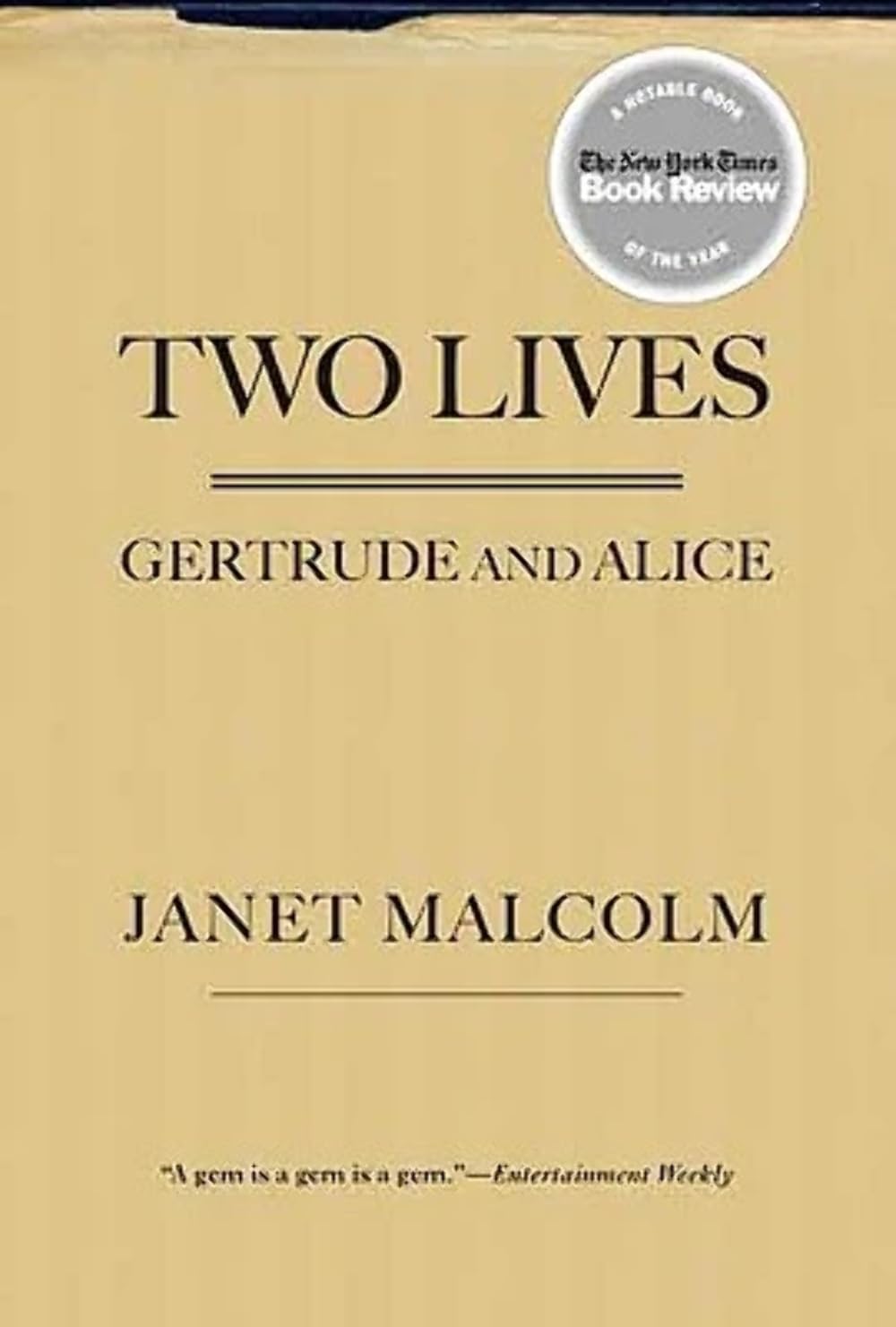
When I was younger there were several long gone events that I regretted missing, the long lunches at the Algonquin Hotel with Robert Benchley and Dorothy Parker, the parties on Long Island with J. Gatsby looking for Daisy, bumming around Europe with Hemingway, and the Paris soirees with Gertrude Stein and Alice Toklas. (And if someone had told me about Max's Kansas City in New York I would have run away from home to get there). The best book that I ever read on Gertrude and Alice was James Mellow's Charmed Circle, which is a standard conventional life of Stein, Toklas and their circle expatriates which included Henri Rousseau, Matisse, Picasso, Hemingway, and Fitzgerald and went on for nearly 40 years in all manner of conditions. There was also Stein's charming book, The Autobiography of Alice B. Toklas, a memoir as imagined by Stein of her long time partner and lover and Hemingway's Movable Feast.Janet Malcolm's book does not attempt to go over this well-trod ground. There are no stories about the banquet for Rousseau in which all the leading lights of modernism were doing homage to the grand old man of primitive art, no tales of how Picasso's portrait would one day look like Stein, the words "lost generation" are never uttered. There is no meditation on Alice's unconventional brownies recipe. Instead, Malcolm is attempting to do something different.This is mainly a biography of the reputations of Stein and Toklas and how scholarship and memoir has shifted overtime. Subjects that are not normally addressed, Stein's difficult to read works (Everyone's Autobiography and The Making of the Americans, even Three Lives and Wars I Have Seen), the relationship of the two women, with Alice playing less of quiet retiring role than previous, the way that Stein and Toklas survived World War II, and finally what happened to Alice after Gertrude, a tale that has overtones of The Aspern Papers.This is not the sort of book that one would recommend as the first biography one should read on Stein, the author presumes that the reader is well versed in the comings at 27 Rue de Fleurus and willing to go a little further. What emerges is just how unsure Stein was when she arrived in Paris and for many years afterwards, just how instrumental Toklas was in her development as a writer and how much she was an equal partner in Gertrude's life. If anything Malcolm, by her focus on Alice Toklas, provides a more well-rounded account of their relationship than was previously understood.Malcolm's short book incorporates not only the latest in academic scholarship when addressing the writing that so engaged Stein for many years, but also provides a fuller picture than I have otherwise seen on Alice's life after Gertrude's passing. For such a short book, the subjects emerge far more human and believable than I have seen in previous works.
G**H
A rose by any other name
Gertrude Stein, commenting on her wondrous line, "A rose is a rose is a rose is a rose" said this --"I know that in daily life we don't go around saying 'is a . . . is a . . . is a . . .' Yes, I'm no fool; but I think that in that line the rose is red for the first time in English poetry for a hundred years."No fool, indeed. To have made a lasting contribution to literature with one line? That takes a fool's fool, or rather, the kind of fool Shakespeare used in his plays. The man who could talk to the moon and tease the king at the same time.Gertrude Stein had the fool's charm to speak as she pleased and to throw her literary comments every which way, but it almost seemed she didn't care to be read. Maybe heard. But not necessarily read.Very few people I know have read Stein's big book The Making of Americans.The biographer of this many-faceted book, Janet Malcolm, says she couldn't read The Making of Americans until she solved the problem of the book's weight and bulk by cutting it up with a kitchen knife into six readable, and also portable, sections. In this way she made a discovery -- "It's a book that is actually a number of books."She also says: "If you listen to the book's music, you will catch the low hum of melancholy. If you regard it as an exercise in whistling in the dark, you will understand its brilliance."Malcolm is right. The music of a book is often the point of the book, and should be read as if one were listening rather than reading.But the great brilliance of Malcolm is that she writes sympathetically about the genius, Stein, and her cohort, lover, best friend, mate and savior, Alice B. Toklas. Their lives are intricately interesting, more so than Stein's prosody perhaps, but then, as Gertrude might've said: You get what you get and that's what you got.
E**L
It made me despise Gertrude Stein and Alice Toklas
Though I use the Toklas cookbook (her recipes for bouillabaisse and for omelets can't be beat), and I liked The Autobiography of Alice B Toklas, I couldn't bear Stein's experimental writing. No one thinks to mention that while she was an undergraduate at Radcliffe she participated with psychology Prof. William James in experiments on automatic writing. As Prof. B.F. Skinner pointed out, in an Atlantic article in the 1930's, Stein simply copied (or adapted to her egotistical purposes) the automatic (mindless) method of writing: that was her big innovation! Most of all, learning more about Stein's political views - her admiration of Mussolini and Franco, her indifference to the suffering of French Jews during the Nazi occupation of France, her taking help from French anti-Semitic fascists -- all that made me despise her. Neither she nor Toklas would ever acknowledge that they were Jews and their independent way of life depended on the commercial enterprises of Stein's Jewish family back in the States. It is also shocking and dismaying to learn that Stein's family abandoned Toklas, who had lived with Stein for more than 40 years, and let her become destitute after Stein died. (Friends collected money to keep her going.) In her will, Stein gave Toklas the use (including the sale to support herself) of Stein's fabulous art collection, but the Stein family thwarted her by spiriting away the art work. Altogether a despicable family. Can't blame Janet Malcolm for that. She did a wonderful job of uncovering new information and telling the story, as always, so well.
S**R
Five Stars
Very interesting and easy to read.
T**M
Five Stars
Love this book!
P**R
Malcolm on Stein and Toklas: A Winning Combination
This is another exceptional exploration by Janet Malcolm of an artist's life (and the life of her long-time companion) that allows to consider the nature of biography and autobiography. Of the latter Malcolm writes:"Biography and autobiography are the aggregate of what, in the former, the author happens to learn, and, in the latter, he chooses to tell. A cache of letters between Stein and a rabbi may be discovered that will cast a whole new light on Stein’s Jewish identity. Such discoveries are a regular inconvenience of the biographical enterprise." (192)Until a couple of years ago, I knew of Gertrude Stein for the phrase "a rose is a rose is a rose", and for being an early supporter of modernist painters like Picasso and Matisse. She was not otherwise to be taken seriously. Then I read "The Autobiography of Alice B. Toklas by Gertrude Stein" and realized something much more important was going on. That book, half-way between a novel and biography, with its inimitable style, allowed Stein to write about herself in the third person, and among other things to proclaim herself a genius. These are the features that appear to have intrigued Malcolm. She manages to accomplish three remarkable things in this relatively brief book: (1) to explore the main controversies surrounding Stein and Toklas' lives in France during the Second World War, i..e., whether they were ‘coddled’ by the Vichy regime, and turned a blind eye to Jewish persecution (rough conclusions: they were and they didn’t, living in relative isolation in the village of Bilignin); (2) to assess Stein's achievement as a writer and novelist, especially in her most 'difficult’ book, the 1000 page long “The Making of Americans.” Malcolm argues convincingly that Stein is an important original writer, and indeed likely a genius in that regard; (3) to explain aspects of the relationship between Stein and Toklas. The former was often childish and needed to be taken care of, and Toklas did the taking care of, including, for 30 years after Stein's death, of her literary legacy. However, there are hints that they fought at times and in those fights, Toklas likely had the upper hand. The last of four Parts of Malcolm's book relates events from those last 30 years, and manages to add to Toklas' portrait from the famous Autobiography.In short, this an excellent and thought-provoking read on its human subjects, and on the art and the limitations of biographical research and writing. It's another treasure from the life's work of the late Janet Malcolm.
Trustpilot
1 month ago
5 days ago